doktorjohn.com

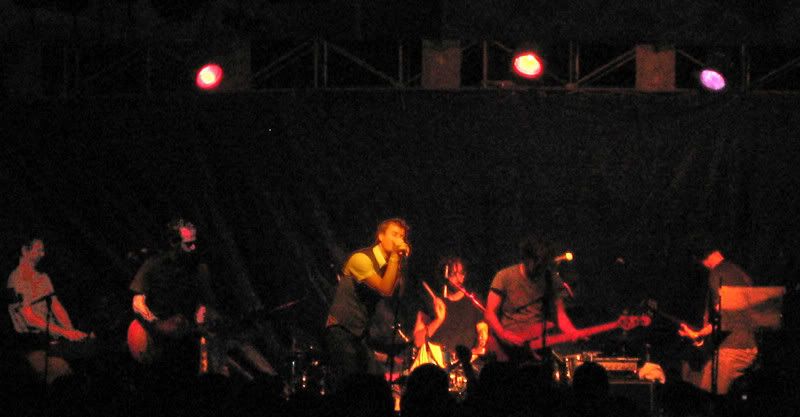
Mike Ness at The Stone Pony

Filed under: Live Music,Reviews — doktorjohn May 16, 2008 @ 2:16 pm

Asbury Park, NJ

Mike Ness, frontman for the classic punk-hardcore band Social Distortion and virtuoso guitarist, now performs and records mainly under his own name. His touring band is made up at least partly by members of Social Distortion. On May 16, 2008 he brought his tour to this landmark club, a venue with which he was sufficiently familiar to spark his comments about changes in the urban environment of that decaying Jersey shore town.
Heavily-inked and hair slicked back, Ness took off his Stetson hat and opened with one of his originals, “The Devil in Miss Jones” and then proceeded quickly to an upbeat cover of Bob Dylan’s “Ain’t No Use.” He continued for over an hour during which he accomplished his miracle of converting an audience of hard rockers into country-and-western fans for a night. Homage was paid to pioneers Hank Willliams with “All I Do Is Cry,” Carl Perkins with “Let the Jukebox Keep on Playing,” and Johnny Cash with “Ballad of a Lonely Man.” There were, of course, Mike Ness originals, too, including “Cheating at Solitaire,” “The Rest of Our Lives” and “Misery Loves Company.”

The mainstay of his repertoire remains autobiographical like the Social Distortion classic “Story of My Life”, but Ness also revives bluegrass classics and depression-era standards. Encores included his own “Charmed Life,” Mike’s expression of gratitude for his survival and success, rendered without irony, which says a lot about the heart of this great artist. Ness called for recognition of the openers, Jesse Dayton and his band, authentic representatives of the style that Ness, former punk rocker, in his artistic maturity has now adopted.


In the end he included two standards, “I Fought the Law” and “Ring of Fire.” The lyrics to Ness’s body of work, including both his solo material and that of Social Distortion, have laid bare the painful tribulations which he survived: substance abuse, the untimely loss of a friend, shattered relationships. On this occasion he didn’t perform his signature anthem “Ball and Chain.” Perhaps he no longer needs to plead that they be taken away. But in “Dope Fiend Blues” he reminds us that he “sold my soul to the Devil, and then I stole it back.”

While his early biography may have been a tale of woe, his grateful acknowledgement of how well things have turned out is shown by his resolute and grateful homage to “roots” Americana. Mike Ness has earned the status as a national treasure.

Mike Ness Aquarian Interview

Filed under: Live Music,Reviews — doktorjohn April 30, 2008 @ 1:20 am


I phoned Mike Ness on the morning after the first night of his cross-country tour. Frontman for the three decades-old, hard-core, punk band, Social Distortion, Ness has been recording and performing solo material since around the time of the 1999 Woodstock Festival, which is where I first saw him live. At that time he captivated the crowd of with his utterly sincere manner and rock-with-a-country-twang style. He is a multi-talented singer, songwriter, artist, clothes designer and customizer of vintage cars. Punk and hardcore have come and gone, sending both the celebrated and the little known to obscurity. Yet after thirty years, major personal struggles and numerous tragedies, Mike Ness and MN: Social Distortion have not only survived, but have continued to grow in success and recognition, adding a second generation of fans to their loyal following.

Mike Ness proved to be a remarkably modest, friendly person to interview. He was quick to give credit to many others in music who inspired him, and clear in his love of America and American culture in all its many expressions.

DrJohn: You’re on the first leg of a tour that’s about to cross the country. How’s that tour going?
Mike Ness: Well, last night was the first night and it was pretty good. We’ll work all the bugs out by the time we get out your way.

DrJ: Are the opening bands mainly local people from the regions your tour is passing through?
MN: Yeah, usually, so they don’t have to travel far.

DrJ: Do you have a big say on picking the opening acts or do your managerial people do that for you?
MN: They initiate it and then I have to approve it. I just try to get someone that’s going to fit and trying also to give them an opportunity to perform in front of a larger crowd than they usually get to do.

DrJ: Do you get contacted much by bands that would like to open for you or that feel they should be performing with you?
MN: (Chuckles) Yeah!

DrJ: What do you think is different about the Mike Ness solo as compared with Social Distortion?
MN: It’s kind of an intangible thing. Certainly it’s different, it’s not as loud, it’s not as fast, it’s more musical, and it’s a little bit harder to play.

DrJ: Are you presently engaged in writing and composing for either Social D or creating Mike Ness solo material?
MN: Absolutely. I’m always writing. Even when I don’t pick up a guitar. I mean I’m living life. And then when I do pick up a guitar I get in touch with those experiences and feelings.

DrJ: A few years back you broke your wrist skateboarding and were unable to play guitar for a while. Did that make it difficult for you to write & compose?
MN: Yeah, that made it difficult to do anything. I usually compose on the guitar and so there wasn’t much writing going on in that period, for those few months.

DrJ: Do you see yourself as part of the country & western genre?
MN: I’m really on the outside. It’s never been my desire to get on the inside of that. I listen to mainstream country and I say, ‘Yeah, that’s cool, but this is how I see it.’

DrJ: Would you agree that your more recent Mike Ness solo music was more derived from country & western than is the Social Distortion stuff?
MN: Yes, although that’s the stuff I grew up with until I got into punk music. Then I kind of set country on the side. But in the early ‘80s I started to revisit it. And there were bands like X and the Scorchers that I liked. I really like that connection of rock with American roots music whether it’s country, blues, rockabilly, bluegrass or folk. I just like connecting the two styles, then giving it a bit of an edge.

DrJ: In regard to your early influences, did you grow up with Elvis Presley’s music? Or was that before your time?
MN: There was a little bit of that, of that mid-sixties, late sixties stuff. But I grew up mainly with the Beatles and the Stones on my mom’s side and Johnny Cash and bands like the Dillards on my father’s side. He was the country guy. And my uncles were rock’n’roll. It was like the Smithsonian ‘Folkways Box set’ was around the house. Then it just progressed into the glitter years, to Ziggy Stardust and to T Rex and little bit of Kiss. Then I got into the Clash and the Sex Pistols. When the Ramones came around, I was like, “This is it. This is going to be my whole life.”

DrJ: You are known for having a taste for 1950s retro styles in cars and clothes. Where do you think that those interests come from?
MN: Well, early experiences. For example I think about when the Hell’s Angels had short hair and when my uncles were riding on low-rider-style motorcycles and building Harley trikes, it’s all American culture. I absorbed everything from Elvis Presley to ‘The Lords of Flatbush’ and I remember saying “I’ve got to comb my hair like that!” A lot of it began in my mind with the Clash dressing like early American gangsters and me thinking, “We should be dressing like that because we are American.”

DrJ: Is there a future to Social Distortion or will it just be Mike Ness solo from now on?
MN: There’s no end in sight for Social D, I can tell you that.
We want to do a documentary. We want to do a stripped down, acoustic record with our favorite songs from our catalogue and do a kind of a Springsteen/ Dylan approach, maybe a Neil Young unplugged approach to these songs. It wouldn’t be much new stuff, though. Except that I would put a couple new things on the record. But primarily I’m saving my new stuff for a studio album that I would like to do next year.

DrJ: Do you agree that a lot of your early stuff was self-critical and despairing?
MN: Yeah, ‘White Light, White Heat White Trash’ was particularly dark, more so than any of the others. But that’s where I was at that time in my life.

DrJ: Now that you’ve emerged as a cultural icon do you feel happier these days due to the success you’ve experienced of late?
MN: Definitely. We feel very lucky to be enjoying this amount success so many years into our careers. It’s lucky for us to have lasted this long, and to be more popular now than we were in the beginning. For most bands it‘s the other way around. They’re at first popular and then twenty years later they’re trying to relive that. But for us, it’s been the complete opposite. To me it’s baffling; I’m like “Wow! What a trip! How cool is this?” We feel very, very grateful. I know I am very, very lucky.

DrJ: Good luck with the rest of the tour.
MN: Thank you. I hope you can make one or two shows when we’re in New York or in New Jersey.

Mike Ness will be performing in Philadelphia, May 12; in New York, May 13 & 15; and in Asbury Park May 16 & 17

Below is a pdf of the page as it appears in The Aquarian but reduced in size to fit this blog 😉

Bauhaus’s Final Bow – “Go Away White”

Filed under: Recorded Music,Reviews — doktorjohn March 27, 2008 @ 12:50 am

“Deface” —the Movie

Filed under: Friends & Family,Movie Reviews — doktorjohn March 9, 2008 @ 3:30 am

“WHEN YOU CAN’T SPEAK FREELY, REBELLION IS AN ART”


Those who haven’t yet seen the riveting short film Deface by John Arlotto have a chance to catch it in Asbury Park, N.J. in early April. This film short has won many awards and has been selected for entry into many festivals. It has has an extended life on the film-festival circuit and will be coming to the Garden State Film Festival, April
4-6. I am so pleased the film will finally make its official debut in the
great state of New Jersey.

The film festival takes place in Asbury Park. DEFACE will play with a group
of short films on Saturday April 5th at The Stephan Crane Theater at 2:30pm
and later in the day at the Berkeley Hotel at 5pm. Please consult
www.gsff.org to confirm the details.

Veronica Puleo/Read Between The Lives/MMI Records

Filed under: Recorded Music,Reviews — doktorjohn November 14, 2007 @ 2:43 am

This singer-songwriter, originally from NJ, moved to Miami and is now a fixture in LA’s live music scene for the past 8 years. She chose the folk-rock idiom for her autobiographical retrospective on the various “lives” she has lived, first growing up a subjugated daughter in a Sicilian home then through various stages of liberation, maturation and artistic success. Her wide-ranging vocals are sweet and supple, reminiscent of Tracy Chapman. People in her past who tried to suppress her personal fulfillment are given retroactive castigations in darkly poetic pieces like “Rearview Mirror,” “I’m Still Me” and “Light of Truth.” Although the overall attitude is often bitter, the compositions, her voice and her arrangements are always beautiful. All is not accusation. Some tracks are retrospectives of gratitude and admiration. The finale is a jaunty, ironic Italian folksong song that makes peace between Veronica and the past that she does not totally reject.
B+ In a word: Bittersweet

The National at River-to-River Festival NYC

Filed under: Live Music,Reviews — doktorjohn September 7, 2007 @ 7:52 pm

South Street Seaport / August 17, 2007
by Doktor John /
New York City

New York’s “River-to-River Festival” hosted up-and-comers The National on a drizzly Friday night to a huge crowd of clean-cut hipsters.

You can no longer consider yourself hip, nor the possessor of secret knowledge about a brilliant undiscovered band, when you hear them featured on National Public Radio. That’s what happened as I tuned my car radio en route to my first performance of TN.

Originally from Ohio, now Brooklyn-based, these indie rockers can be seen as epitomizing mellow middle America, with their happy-sad, musically engaging songs, in the emotional style of Toad the Wet Sprocket.

Characterized by brilliantly composed and ingeniously arranged pop—the kind that rarely gets play on commercial radio or MTV and sounding reminiscent of Modest Mouse or Interpol in a state of clinical depression, the six-man TN plucked heartstrings with heavy themes, soft-spoken lyrics, marching-band rhythms, and hook-laden melodies that immediately took hold of the listeners’ emotions.

    Singer Matt Berninger (whose has some of the vocal qualities of 60s folk giant Burl Ives) used his considerable skills sparingly, sometimes lapsing almost into quiet speech or holding back completely, allowing the ingenious arrangements and highly capable musicians to carry the crowd to heights of listening pleasure .

   They opened with the mellow “Start a War” and played for a little over an hour, featuring many well-known (in any case well-known to that crowd) tracks including “Fake Empire” and the upbeat, rousing “Abel.” They’re supposed to be a quintet according to their website, but I counted 6 performers on stage. The violinist particularly added a touch of hard-rocking zest to an otherwise sedate musical style.

   So seductive were the National’s mesmerizing melodies and their compelling cadences, that I have remained hooked on them for days afterwards, and at this point find myself obsessively listening to nothing else as I search out everything in their repertoire for my collection!
Link to their website The National

Ninth House/ Realize and It’s Gone/ Sinister Records

Filed under: Recorded Music,Reviews — doktorjohn August 22, 2007 @ 3:05 am

This, Ninth House‘s third full length album continues in the band’s deep, dark, cemetery & western style featuring the moody poetry and vocals of baritone Mark Sinnis. Twelve tracks are offered, ranging from metal-flavored country rock to smooth, plaintive ballads to jangly honky tonk. As in their prior CDs, minor key melodies prevail. Ninth House ventures beyond the level of pessimism that is customary in traditional country & western to the extent of crossing over into Gothic rock. All songs are originals except the 1948 antique, “Ghost Riders in the Sky,” resurrected in a commendable version reminiscent of Sinnis’s idol, Johnny Cash. The title track is a gem, an intoxicating anthem that unites existential protest with passionate, irresistible hard rock. Though the topics are generally dark and the melodies mournful, the driving rock rhythms and exuberant guitar accompaniment ironically lift the listener to a kind of nihilistic euphoria.

Rock Meets Opera/ East Village Opera Company/ Town Hall/ NYC

Filed under: Live Music,Reviews — doktorjohn April 27, 2007 @ 2:38 am

The merging of rock with classical music has been tried from time to time over the years, dating back at least as far as 1967’s “Classical Gas” by Mason Williams and Walter Murphy’s disco entry, “A Fifth of Beethoven,” both based on instrumental, rather than vocal works.
Rock operas such as “Hair” and “Jesus Christ Superstar” and virtually everything by Andrew Lloyd Weber represent original compositions done in semi-operatic style. The East Village Opera Company’s effort is different in that it consists of faithful versions of classical operatic arias performed in true rock style, both vocal and instrumental.

The ensemble consists of a drum set, electric piano played by the EVOC’s mastermind Peter Kieswalter, two guitars, a bass, three violins and a cello, plus two vocalists, one male and one female.

The performance opened with Mozart’s “Marriage of Figaro” as shaved-headed, mod-attired vocalist Tyley Ross bounded on stage, strutting like a young Mick Jagger while the music swelled in a bombastic Queen-like accompaniment. Next followed the Puccini aria “Che Gelida manina” from Boheme and a bluesy “Questo o Quello” from Verdi’s Rigoletto.

The music turned funky for a duet from “Lakme” in which Tyley was joined by the incandescent AnnMarie Milazzo whose vocal skills just barely exceeded the appeal of her dangerously hot, wet-tee-shirt-worthy physique.

Just before the first intermission, Tyley went solo for an upbeat version of Puccini’s triumphant “Nessun’ Dorma,” made the most popular tenor aria by Luciano Pavorotti a generation ago.

They returned with “M’Appari” a familiar melody that everybody knows, but few have heard performed in art rock style. The ironic “La Donna e Mobile” and venerated songs from “Carmen” and “Madame Butterfly” received the classic rock treatment.

The EVOC was joined by an actual diva from the New York City Opera company to sing an up tempo aria from “La Traviata,” and the audience got an opportunity to listen in awe to a real operatic singer whose voice and vocal skills literally dwarfed those of the gracious and humble EVOC.

A Neapolitan song, ”Mattinata” and “The Pearl Fishers” brought a temporary close to the show, but they returned to thunderous applause with Wagner’s “Ride of the Valkyries,” then did some tongue-in-cheek rap and the rockingest “Vesti La Giubba” from “I Pagliacci” ever.

A packed house at NYC’s Town Hall roared their appreciation repeatedly, and this uniquely talented ensemble eventually brought both young hipsters and gray-haired baby-boomers to their feet in a foot-stomping, hand clapping, and head-bobbing frenzy.

At first it seems like the ultimate clash of styles. Antiquated, somber and aristocratic opera meets lurid, exuberant and radical rock. But both rely heavily on passionate, vehement and intense expression. The combined style takes advantage of the most delicious melodies ever written —sometimes rousing, often exquisitely heart-breaking— but couples them to the compelling rhythms and the freedoms that go with rock— freedom to twist and bend notes, modulate keys and accelerate rhythms for emotional effect. The EVOC does this with fantastic artistry, mastery, and loving respect for both genres.

The Memory Pain/ Jiggs Tavern/ March 24, 2007/Butler, NJ

Filed under: Live Music — doktorjohn March 24, 2007 @ 2:07 am

   A really accomplished cover band is a unique pleasure. Sure, we all respect creative and innovative rock music writers and composers. But lets face it. Aren’t 99.99% of them beating their heads against a wall for their entire careers? The time spent mastering their craft, the investment in instruments, equipment and recording costs are rarely if ever recovered. The fact is that most attendees at live music performances would rather pay to hear the songs they love and remember performed live rather than try to fathom whether or not they are listening to the next, yet-to-be-discovered Nirvana.

   Well, The Memory Pain is comprised of five guys who have put in the time and paid their dues contributing to and performing with highly acclaimed, highly creative original-music bands that never got signed to a label. Their love of the music that they grew up with remains undiminished. And let’s face it. The years of practice they put in, and their natural talents are assets that have to be expressed.

 These are really accomplished performers. Frontman Fred Hays has the talent and vocal range that enable him to re-animate such cherished entries as “I’ll Melt With You,” “You’re All I’ve Got Tonight”— even “Mystery Achievement.” The virtuoso accompanists and sometimes-vocalists including Byron on drums, Dan on bass, Jason on guitar and Doug on keyboards somehow replicate enough of the arrangements to match the sound of the originals with the added pleasure and spontaneity of a live-and-in-person feel.

   Nothing is more entertaining, really, than an evening of our favorite songs performed with astounding mastery and energetic intensity that a group like this can bring to the music we all have known and loved throughout our years. And do they give you your money’s worth! For three hours, with a short intermission break, The Memory Pain pours forth lovingly crafted, respectful versions of the best from the 70s, 80s and 90s.

   This was the second time I witnessed one of their marathon sets, and I really can’t think of a better way for a fan with a healthy knowledge of rock music history to spend an evening. The Memory Pain’s ever-expanding repertoire will please and satisfy anyone who has an interest in the musical history of the last quarter of the 20th Century. And those who are nostalgic for the passion that they felt when they first experienced New Wave, Goth, and Alternative, will find it to be “Just Like Heaven”

Secret Machines/ High Line Ballroom

Filed under: Live Music — doktorjohn January 19, 2007 @ 4:14 pm

It was no surprise that The Secret Machines was selected to top off the High Line Festival, a 10-day combination of music, art and performance celebrating the inauguration of work to renovate a stretch of elevated rail running up the west side of Manhattan through Chelsea to convert it into a public park-in-the-air. This trio, originally from Dallas, but currently living in New York City soared into fame and acclaim on the basis of tight, elegant Led Zeppelin-meets-Pink Floyd brand of power rock.

So it was a profound letdown when, following two excellent, anonymous opening bands (when, oh when, are rock venues going to make clear announcement of the identities of openers?) and a dazzling light-show prelude, TSM began, not with one of their beloved anthems, but an unfamiliar and uncharacteristic ballad…or two…or five.

No longer a trio, having lost guitarist Benjamin Curtis recently, they replaced him with not one but two performers, thus transforming TSM into a quartet. Scorning the audience’s desire to hear their many established hits, TSM chose to push new material obviously intended for a yet-to-be-assembled third album. Worst of all, they failed to intersperse the new material with recognized songs.

Unfortunately, the new material has none of the qualities of their prior efforts. Brandon Curtis completely changed his vocal style. Gone are the compelling, driving cadences. Gone the catchy, melodious hooks. Gone the intriguing lyrics! Instead the rhythms are erratic and shallow, the melodies monotonous and unsatisfying, the lyrics preachy and pretentious. The bass guitar issued buzzing belches that removed any resemblance the music might have had to their former repertoire. Between these half-baked songs there were irrelevant drum rolls and guitar and synthesizer riffs. All throughout the show, the band members seemed to be distracted, frantically gesturing hand signals to each other and to the off-stage staff.

It’s as if TSM had been replaced by imposters who knew nothing of the originals, and who trying to foist their own inferior material on fans. A confused but loyal and forgiving audience accepted this misguided departure from TSM’s former style with lukewarm applause. After an hour of bitter disappointment, I lost my desire to hear the songs I had sacrificed a Saturday night to hear. I had no trouble convincing my companion to leave, even as TSM began reverting to their old repertoire. We got up and walked out, wondering if it would be appropriate to ask for our money back.

<<< Previous Page - Next Page >>>