doktorjohn.com

New Album by Social Distortion

Filed under: Recorded Music,Reviews — doktorjohn February 12, 2011 @ 2:31 pm

Social Distortion/ Hard Times and Nursery Rhymes/ Epitaph

By Doktor John

This newest album by the resurgent ‘80s “punktry” group Social Distortion comes in two versions, regular and deluxe, the former containing eleven and the latter 14 songs.

Times and styles change, and bands themselves evolve. Frontman Mike Ness has forged a solo career of late, and this album reflects his delving heavily into what he calls “roots” music, mostly good ol’ country and western with an added element of blues.

A lightening-fast, two minute instrumental overture titled “Road Zombie” starts the set with twangy guitar showmanship followed by bluesy, autobiographical “California (Hustle and Flow).”

“Gimme the Sweet and Low,” “Diamond In the Rough” and “Far Side of Nowhere” are each in the melodious country-rock style into which Ness lately crosses over.

“Machine Gun Blues” rises to a symphonic level, with retro-themed lyrics and a cinematic narrative. “Bakersfield” is a six-minute magnum opus in the form of a lament for a faraway gal containing a Johnny Cash-style, spoken-word confession of obsessive desire for her company.

“Alone and Forsaken” is a minor-key, dark Gothic poem in the “cemetery-and-western” mode that is just beneath the surface of much of Ness’s works.

“Can’t Take It With You,” a clichéd piece of pseudo-gospel nonsense, far below the musical standards of the group, should not have been included in this album. Otherwise the rest are great retrospective of the rockabilly lifestyle — utterly sincere, with equal doses of regret, honesty and the personal tenacity characteristic of Ness’s late, autobiographical works.

Rating A

In a word: True to form

The National at Radio City

Filed under: Live Music — doktorjohn June 19, 2010 @ 12:39 am

The National/ Radio City
June 16, 2010
By Doktor John
New York

Few events are as disappointing to a music-fan as a poor performance by a favorite band. In the past few years, The National has been catapulting from Cincinnati obscurity to Brooklyn hipster notoriety to national (no pun intended) renown on a perfect mix of clever melodies, offbeat rhythms and poetic, self-effacing lyrics delivered by frontman Matt Berninger’s velvety, understated baritone.

This night, besides Beringer, there were one or two alternating backup vocalists, a couple of keyboards, guitar, drums, bass and a brass duo with trumpet (or such) and trombone. They played favorites like Secret Meeting, off the album Alligator and Squalor Victoria off Boxer; plus plenty from their latest release, High Violet, such as Bloodbuzz Ohio, Anyone’s Ghost, Afraid of Anyone and Conversation 16.

Their live performances, two of which I previously had the pleasure to attend, have provided joyous, transcendent moments of musical rapture. Why did this all fail to happen this night?

Radio City’s
performance by The National went wrong, very wrong in every particular. Something about this grand, imposing venue must have provoked an insanely inappropriate intent to overstatement and bombast, the last things one wanted to hear from The National. Instead of singing in his inimitable, warm style, Berninger screamed his words, discarding all the musicality of his lyrics. His soft baritone was transformed into harsh barking.

The National usually employs touches of brass for neat, limited color accents to the songs, but here a trumpet and a trombone blasted prolonged, piercing cries over and in opposition to the melody. The bass drum and bass guitar were so disproportionately loud and thunderously deep that the audiences’ chest cavities shook, even way up in the second and third mezzanines. The people in front of me were holding their fingers in their ears to shield against the criminally painful highs with which the sound team assaulted us.

The only song in their repertoire for which this kind of chaotic, noisy approach actually worked was the hard-rocking Abel, which we heard as we exited early from the show, disappointed at being unable to enjoy the performance but still convinced that The National is one of the best bands to come along in the new millennium.

The Night’s Last Tomorrow

Filed under: Recorded Music — doktorjohn @ 12:33 am

CD Review
The Night’s Last Tomorrow
Mark Sinnis

This is the third CD released by the frontman for Cemetery-and-Western band, Ninth House, and it is rich with both new material and mature, acoustic reinterpretations of older songs, often featuring brave and innovative instrumentation to accompany Mark’s bitter-sweet, chocolatey vocals. Some songs have appeared on Sinnis’s two prior solo albums and Ninth House recordings. Mark hasn’t dropped his unwavering focus on death and how awareness of it causes us to see life’s experiences in a certain light.

The opening track, “The Night’s Last Tomorrow” epitomizes this concept, and reaches heights of languid sadness thanks to the moody lap-steel guitar of bluesman, Lenny Molotov.

“15 Miles to Hell’s Gate” has a more frustrated, angry tone, whereas “Your Past May Come Back” is surprisingly upbeat and showcases Marks’s amazing, mellifluous vocals.

The “western” in “Cemetery-and-Western” is evident in “Fallible Friend.” My own particular favorite, “Follow the Line” is a dark, Ninth House treatise about suicidal-drunkenness that is incredibly melodious, even in this relatively light, accordion-accompanied version.

Other tracks include new originals as well as acoustic tributes to the Sisters of Mercy, stripped down versions of songs by Sinnis’s old band, The Apostates, pieces with names like “Skeletons” and “Scars,” plus a New Orleans-flavored Louie Armstrong cover and Billy Holiday’s “Gloomy Sunday.” The album ends appropriately with a country gospel death-march.

Sinnis’s style is a blending of folk-rock and traditional country, western, gospel and blues that is sure to please as well as fascinate music lovers of every stripe..

Sculpture of John DiTunno M.D.

Filed under: Art Reviews,Friends & Family — doktorjohn March 12, 2010 @ 11:10 am

I recently had the privilege to make the acquaintance of a true Renaissance Man, retired professor of Physiatry (that’s Physical Medicine and Rehabilitation), John DiTunno, M.D.

Dr. DiTunno is an amateur sculptor who has, among his many artistic accomplishments, re-interpreted Andrew Wyeth’s famous painting, “Christina’s World”, bestowing upon it a higher-still level of immortality by actualizing the image in stone!

Here we see his sculpture,“Christina,” and below it, Wyeth’s masterpiece, “Christina’s World.”

As we know, Wyeth’s painting portrays a handicapped lady who was renowned in her small world for having borne and in significant measure surmounted a physical disability both courageously and with dignity.


Just as John DiTunno, a physician who spent his life helping the disabled to overcome their physical limitations was inspired by Wyeth, so too a colleague of his—another professor of Physical Medicine and Rehabilitation, Margaret Stineman, M.D.—was inspired to pen this beautiful poem in homage to John’s creation!

Tim Burton at The Museum of Modern Art

Filed under: Art Reviews,Reviews — doktorjohn January 16, 2010 @ 11:27 pm

Tim Burton at the Museum of Modern Art
Nov 2009 – April 2010
New York
By Doktor John

Surrealist and multi-media artist Tim Burton is the subject of a major exhibition at New York Citys MoMA that must be seen by everyone interested in pop culture. Attendance is overwhelming and it requires reservations well in advance. One of the first things one notices is the enormous body of work that he has churned out over the years. Known mainly for motion pictures like Mars Attacks and Batman which feature his eccentric design style, Burton is revealed to be an amazingly prolific and gifted in ink and in paint, on paper and on canvas, since very early in his life. Just as his movies seem to want to bridge the gap between child-like innocence and true horror, so too his witty and light-hearted drawings are filled with fantasy creatures that have dislocated eyeballs and with predatory clowns menacing with pointy teeth. Some of these have been translated by sculptors into jaw-dropping constructions and assemblages.

The lightly-colored pen-and-ink drawings include recognizable personalities such as Joey Ramone, Vincent Price and Alice Cooper. Others are anonymous humans with distorted body parts, aggressive toys or nightmarish yet comical fantasy-creatures. They are typically composed of weirdly proportioned, wiggly shapes that might have been drawn by Aubrey Beardsley intoxicated with absinthe, or by Edward Gorey if he executed them with his left hand. Many are hilarious visual puns. One entitled Tongue-twister displays a creature maliciously twisting a mans tongue as if wringing out a wash rag.

More than 700 pieces are on exhibit and include concept drawings for the characters in his movies, recognizable iconic mannequins, costumes and statuettes from both his animated and his live-action films. Among them are Catwomans costume, a life-sized effigy of Edward Scissorhands, and numerous statuettes representing the various creatures in the stop-action movie, The Nightmare Before Christmas.

The monstrous, threatening Jack O Lantern from Nightmare hovers ten feet above the milling crowd of spectators and a crude ape-head with wooden-branch antlers from Planet of the Apes is mounted high on a wall evoking the feeling of strange otherworldliness.

This exhibition tells us much about post-modern culture, about ourselves and about the creative process. Tim Burton has spent a lifetime arduously and playfully exploring the borderland between the naive fun and the malignant fears of childhood which continue to haunt us well into adulthood.

This is the full page article as it appears in The Aquarian, unfortunately too small to read in its reduced form, here. The text is above the image in legible form.

Nitzer Ebb/ December 4, 2009/ Gramercy Theater

Filed under: Live Music,Reviews — doktorjohn December 10, 2009 @ 4:20 am

Douglas McCarthy of Nitzer Ebb

A brisk and damp Friday night on Manhattan’s East 23rd Street saw a collection of die-hard industrial music fans gather outside the Blender Theater to worship one of the earliest and most eccentric pioneers in the style, the English band, Nitzer Ebb on tour to promote their new album named—what else?— “Industrial Complex.”

Dating back to the genesis of the industrial scene around 1983, these boys present a theatrical image in keeping with their weirdly unique brand of music, complete with pseudo-Germanic and pseudo-militaristic affectations. In that sense they resemble another band from that era, Laibach, known also for counterfeit German and military affectations. One major difference is that while Laibach worked from revisionist versions of cover songs, Nitzer Ebb does mainly original material consisting of harsh, repetitive, mantra-like lyrics shouted over pitiless electronic percussion and the absence of melody. The very name, Nitzer Ebb is an enigma, evoking a kind of dismal, hard feeling, but with no particular meaning, and in fact, no consistent pronunciation.

They have managed to maintain a surprisingly high profile, touring with such big names as Depeche Mode and contributing to the soundtrack of a recent horror flick, “Saw VI.”

In Nitzer Ebb’s heyday, frontman Douglas McCarthy used to appear in military jodhpur pants and knee-high jackboots, but this night he greeted the New York crowd warmly in shades, a suit, white shirt and tie, and in stark contrast with the punkish bandanas, mohawks and construction-booted attire of the audience.

The show opened with the rapidly paced, “Promises” from the 1989 album “Belief.” Next, “Let Your Body Learn” from 1987’s “That Total Age,” similar in style, followed. Dancing, gyrating and strutting around frenetically on stage seems to have kept McCarthy in superb shape.
“Shame” from the 2006 compilation “Body of Work” had a funkier rhythm but increased the brutality index. “Lightning Man,” too, had a sinister sound, emphasized by the hollow, deep, clangy bass-line heard on much of their music, and was livened up with a repeated jazz riff that sounded like it came from a robotic clarinet.

McCarthy’s jacket came off as the performance intensified with song after song featuring their ruthlessly repetitious signature sound. The crowd seemed intoxicated with McCarthy’s angry, barking lyrics and the mesmerizing, motorized cadences. “Godhead” had McCarthy growling to a rapid-fire swing beat.

Gramercy Theater provided a spectacular light show throughout the hour-long concert of around 15 songs, through “Murderous” and “Control I’m Here,” to the climactic closing piece, for which this band is best known, “Join In the Chant.” After a brief intermission, they returned for two more songs climaxing with the finale, “I Give to You.”

Nitzer Ebb certainly pleased the audience with their unique formula of maniacally repeating brutal lyrics (“Lies, lies, lies, lies…Guns, guns, guns, guns!”) over monotonous, thumping mechanical rhythms.

And below is the same article as it appears in the 12-30-09 issue of The Aquarian

Skinny Puppy as published in The Aquarian Decemeber 16, 2009

Filed under: Live Music,Reviews — doktorjohn December 9, 2009 @ 6:50 pm

Most Unusual, the Aquarian published the photo in COLOR!

Skinny Puppy at Nokia

Filed under: Live Music,Reviews — doktorjohn December 8, 2009 @ 4:08 am

Skinny Puppy/ Nokia Theater Times Square
November 17, 2009
New York, NY
By Doktor John

Nivek Ogre of Skinny Puppy

The bizarre performance-art/industrial music project called Skinny Puppy, now in its third decade, continues to outdo itself in every measure from musical creativity to mind-boggling staging to ghastly offensiveness. The current tour, dubbed “In Solvent See” in honor of the economic crisis, touched down in the City at the Nokia, drawing crowds of the region’s most avid industrial culture freaks young and old, many in full cyber-punk regalia.

The opening act was a heavy-metal soloist backed by a digital audio track going under the name Werewolf Grehv. While he proved his abundant dexterity on the electric guitar, what he mostly produced were cadenzas of structure-less noise with no discernible rhythm.

Skinny Puppy came on a little after 9:30 PM, front man Nivek Ogre horrifyingly stooped over an invalid walker, masked and in a huge dunce-cap or Ku Klux Klan hood, depending on how you saw it. If that wasn’t disorienting enough, the lighting consisted mostly of rapid-sequence motion-picture projection that flooded the stage and flickered blindingly, fragmenting the image of the stage set, the musicians and the props constantly.

Musically, they were at their very best, performing many of their early masterpieces like “Addiction” and “Rodent,” but with rich electronic layers added and exceptionally clear vocals. Ogre’s costume came off in a series of unveilings, each time revealing yet another creepy mask or garment underneath. Less common classics were represented such as “Morpheus Laughing” and “Antagonism,” rather than the expected “Testure” and “Killing Game,” which were conspicuously absent.

Newer material from the latter two albums included the bombastic “Pedafly” and the shocking “Politikill.” “Ugli,” off the 2007 “Mythmaker” disc, proved offensive to a handful of the audience who quietly arose from their seats and exited the auditorium when religious imagery was projected on to the background screen. “Assimilate” had political overtones, highlighted by images of the stars and stripes on screen, suggesting a critique of attitudes surrounding immigration.

They took a short break around an hour into their show, returning with their greatest anthem, “Worlock” done in extended version, followed by an unfamiliar piece that featured the monotonous mantra of the word “crazy” repeated again and again. A surprising and satisfying climax was reached with the archetypal “Far Too Frail,” following which Ogre shouted the group’s appreciation to the New York crowd.

Skinny Puppy has gone through break-ups, betrayals, collaborations with other musicians and the destructive withdrawal of key members, even by death. With this, their zillionth live performance in 27 years, Skinny Puppy‘s Ogre and cEvin Key have distinguished themselves as the most bold, inventive masters of the industrial style and creators of a unique brand of music that creates beautiful music out of ugly noise.

Note: I have no idea how I got this excellent photo. If you read the third paragraph (above) you get an idea of how distorted and discombobulated the visual effects were. I took dozens of useless mishmosh photos of unrecognizable light and color patterns that prevailed throughout the show. Yet in one precious instant, everything was clear (see picture) and the photo at the top of this entry is the result!

Myke Hideous Exhibit at Paul Vincent Studio

Filed under: Art Reviews,Goth Stuff — doktorjohn November 1, 2009 @ 6:51 pm

Myke Hideous was among several artists exhibiting at an art oprening held Halloween Night at Paul Vincent Studio, 49 Harrison Street, Hoboken, N.J.

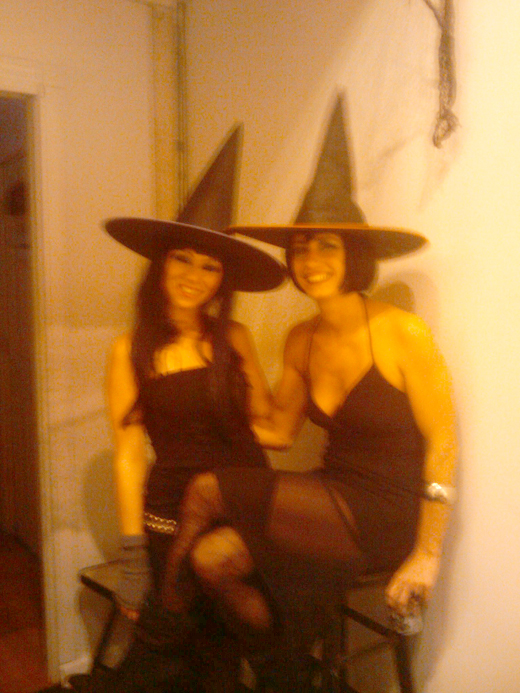
Greeting us at the door

were two of the finest witches to be seen in all of Hudson County that night!

Here’s Myke himself

taking photos of his guests

Marzena was in attendance, but uncharacteristically silent owing to the after-effects of laryngitis!

This is one of Myke complex collage-constructions

which he categorizes as “apocalyptic.” It features a variety of animal skulls, dried flowers and plants, a doll’s head and much more. It has to be seen to be believed, and was priced at a modest $500.

One very impressive painting on wood was this creepy number shown below, called “Escapism.”

Present, beautiful but speechless

(due to laryngitis) was Marzena, shown below.

Franco Battiato at Le Poisson Rouge

Filed under: Live Music — doktorjohn October 22, 2009 @ 10:46 pm

Franco Battiato/ Le Poisson Rouge/ Oct. 19, 2009

New York
By Doktor John

Franco Battiato, one of the greatest figures in modern music, is little known in the U.S, which is nothing short of an outrage. Perhaps it is partly his own fault because Battiato, —who is in many ways the Italian equivalent to Peter Gabriel—rarely spends time touring. This performance in New York was one of only two stops in the U.S., the other a performance in L.A. the preceding night, and this visit was only his second to this country.

Entering the scene initially as a synth-pop genius of innovative prog-rock in the early 80s, he has since delved deeply into experimental and world music, integrating rock with Turkish, French, Persian, German and Brit-pop styles. Fiercely original, yet fearlessly quoting Hendrix, the Beatles and Mozart into his melodies and complex rhythms, Battiato directly addresses the most profound issues of existentialism, modern physics, oriental philosophy, cosmology and sex. His take on politics is serious without being radical, insightful and humane rather than revolutionary.

This night he performed backed by a string quartet, guitarist, pianoforte and synthesizer for a small crowd of fervent, mainly Italian, mainly middle-aged fans whose emotional response was so intense that it threatened to overpower the show.

Drawing from his vast repertoire (I own more than twenty of his albums) he supercharged the audience into a frenzy of cheering, weeping, and singing along with a combination of his new songs and a generous serving of his beloved favorites. Styles spanned the gamut from delicate, meditative pieces like Oceano di Silenzio (Ocean of Silence) and Gli Uccelli (The Birds) to melancholy songs of love such as La Stagione DelAmore (The Season of Love) to spirited, Near-East-flavored rockers like Voglio Vederti Danzare (I Want To See You Dance) and Centro Di Gravita (Center of Gravity).

Halfway through the set he got to the much-adored favorite, No Time, No Space, which is half in English. The audience began singing along and they continued to do so for the rest of the concert. It was interesting to note that the crowd, even those who appeared to be anything but Italian, knew the words and timing perfectly. His one explicitly political entry was a relatively new song in English, Keep Your Hands Off Tibet.

He and the band returned for two sets of encores, which built a crescendo from mild, meditative Prospettiva Nevski to conclude on the frenetic sing-along, Cuccurucuru, a crazed take-off on the classical La Paloma. To have kept a crowd of several hundred middle-aged, middle-class standing and singing until 11:30 p.m. on a weekday night attests to the devotion of this unique artist’s following.

<<< Previous Page - Next Page >>>