Modern English/ Disorder
Click on the link below for a .pdf that you can zoom on for legibility:
10-16 Live – Modern English
My art, music and events scene in NY/NJ
 doktorjohn.com Live Feed
Click on the link below for a .pdf that you can zoom on for legibility:
10-16 Live – Modern English
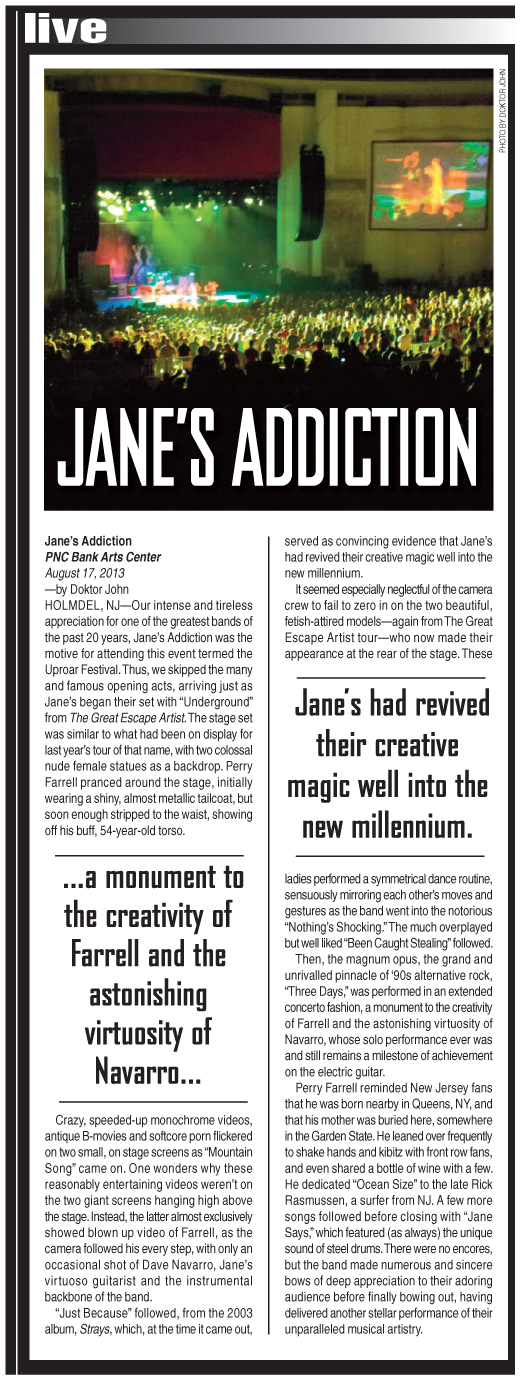
10-02 Live – Jane’s Addiction (1)
If you need to zoom on this image in order to read it, click on the link to a pdf just below this:
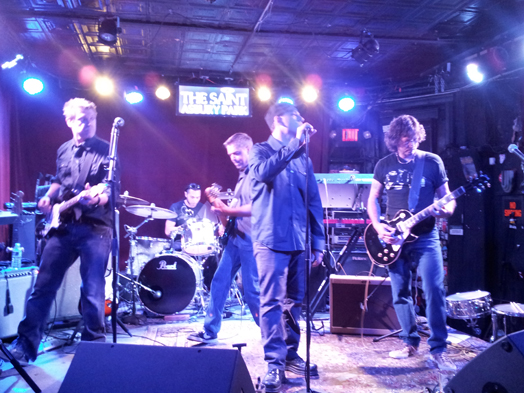
Two bands could not have less in common and yet at the same time sound as near to each other as blood relatives. Disorder, a Joy Division tribute band, is comprised of members way too young to have first-hand familiarity with the music they resurrect. The group which they are covering has a repertoire built mainly from two studio albums with about a dozen songs on each, its full development having been cut short by the untimely suicide of lead singer Ian Curtis in 1980, a mere two years after having gotten started. At least ten of their songs are widely recognized and popular.
By contrast, the headliner band, Modern English, is comprised of mainly original band members, but for the drummer, who is new and, by appearances, young enough to be the son or grandson of the originals. Harkening from the same era as Joy Division and the same Brit-punk/New Wave scene, Modern English has reformed several times, put out six or seven studio albums and wound up credited and renowned for one of the most recognized and beloved songs of a generation, “I Melt With You.”
The Saint, a classic, Jersey shore dive bar provides a gritty, highly conducive environment for live, punk music. Besides the garish Xmas lighted walls and spacious, elevated stage, it boasts a superb sound system and sound engineer who delivered feedback-free audio which was clear and loud, but bearable.
Disorder opened with fast-paced “Shadowplay,” one of the darker entries of Joy Division’s notably dark body of work, then proceeded into “Disorder,” the emotionally charged, repetitious piece after which the band takes it name. It was increasingly apparent that these boys had succeeded in capturing every musical nuance of the originals as they proceeded with such perfectly executed songs as “She’s Lost Control,” the morose “Atmosphere,” and “Isolation,” from which a riff was taken as the basis for sequel band, New Order’s famous “Blue Monday.”
A particularly superb job was done with the unmistakable and widely covered “Dead Souls,” a mesmerizing and demented anthem that, perhaps more than any other piece, represents the mystique of the parent band. Lead vocalist Michael not only captures the vocal qualities of the late Ian Curtis, but his agitated and sometimes spastic gestures as well. Better than any grainy, antique film footage from 1979-1980, Disorder delivers the most credible, if vicarious experience of Joy Division that can be imagined.

Cynics who had assessed Modern English as a one-hit wonder had a real awakening coming. Despite their mature, unkempt appearance, these senior citizens of rock put on a brilliant, tremendously entertaining performance, drawing from their relatively vast repertoire of seven studio albums spanning 1981 to 2010! White-haired, unshaven vocalist Robbie Grey was charismatic and interactive with both the crowd and the band as he led them through a wide spectrum of new and old classics. Included of course was a moving, sing-along version of “I Melt With You.”
Here’s a comparison I can’t prove, but I believe to be true: Joy Division, an iconic band of great notoriety and with a cult following, existed for about 2 years, has two albums and not more than ten songs that can be recognized as hits. Modern English, still immensely entertaining and prolific after thirty-plus years has one hit that is probably essential to more record collections, iTunes libraries, on more iPods, iPads, and mp3 players than everything by Joy Division combined.
In any event, Disorder’s revival of the Joy Division’s body of work and Modern English’s ongoing greatness combined to provide a uniquely entertaining and satisfying treat for rock music fans who have a love for the genre as well as a historical perspective.
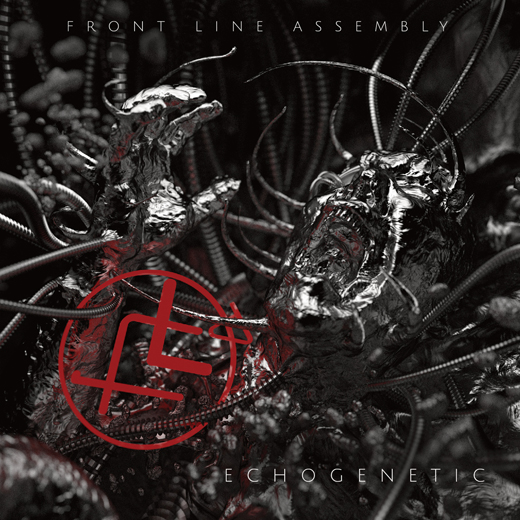
In the 26 years since Bill Leeb left Skinny Puppy, Front Line Assembly has moved in fits and starts through industrial, disco and metal to an increasingly electronic style but always featuring Leeb’s penchant for intensity and harsh themes. FLA’s latest release, “Echogenetic,” represents their 18th studio album, containing eleven tracks. Fans of FLA and of industrial in general, need have no fear: This opus upholds the every essence of the genre as they have come to love it.
The first track, “Resonance” is a slow-paced, emotionally burdensome slog through an electronic swamp with eerie male choral interludes, followed by “Leveled” which introduces a complex and disorienting rhythm, vocals in Leeb’s signature theatrical whisper, a vastly arrayed synthetic soundscape and a delicate bridge of light sounds.
“Killing Grounds” starts with a menacingly rapid, galloping rhythm, brings in distant, undecipherable vocals, and then intermittently slows to a very danceable march.
“Blood” starts out with growling synthesized noise, and then features Leeb’s full-throated singing alternating with the hissing, hostile cries that are the familiar voice of FLA. “Deadened” has a traditional industrial feel, is moderately paced, containing distorted voices, some interesting lyrics and melodious hooks. “Ghosts” starts with a weighty, menacing, slow pace then switches from minor to a major chords for most of the track, gliding back into minor key solemnity as soothing strings intervene to provide short term relief. It would be impossible to sit still while listening to these compelling anthems.
“Echogenetic,” the title track, begins with a misleadingly pleasant, pizzicato string opening, followed by harsh electronic distorted human and instrumental voices and a dragging rhythm that would actually be too slow to dance to.
“Exhale” returns to the signature FLA style, with Bill Leeb vocals and a mesmerizing cadence that will compel listeners to get up and dance. Imagine dancers alternating between frantic, robotic moves and zombie-like catatonia during the erratic beat and rapidly shifting scenario of “Prototype”.
“Exo” recalls classic FLA, sure to please industrial nostalgia buffs. Finally, “Heartquake” closes the album with computer-generated voices (a la Laurie Anderson) in a rondo of dialogue with Leeb’s natural growl.
Aspiring young rockers tend to study the guitar or drums less nowadays, favoring all the electronic, computer-generated and synthetic means of producing music. FLA has a generation-sized head start in that direction. This album, completely guitar-free, demonstrates their total mastery of the new and future genre of techno-industrial music.

Tower
A Trip to the Not-So-Dark Side
This marked the 20th anniversary celebration of this event billed as the “Dark Alternative” music festival held annually in a remote town on southern Poland based in the ruins of a medieval castle and situated an hour and a half from Wroclaw (pronounced Fro-suave) the nearest city. It draws Goths of every age and imaginable wardrobe mainly from Poland, Central Europe or as far away as the U.K. to 3 days of music and camaraderie.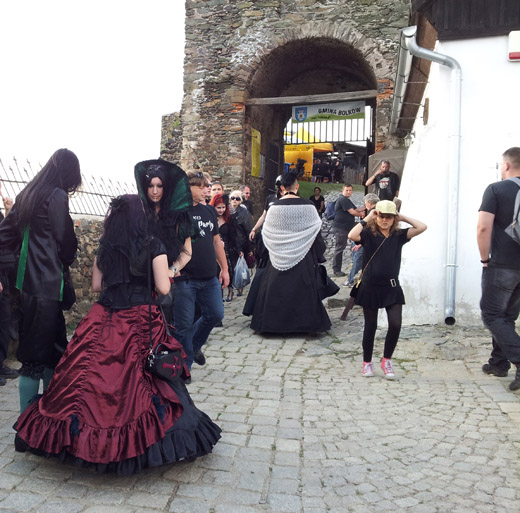 We didn’t find any one other than ourselves who had come from the U.S.A. Live performances took place on a main stage in the courtyard below the imposing tower of the castle and at a gutted, abandoned church a few blocks away. There are two clubs in town where DJs serve up a rotating menu ranging from darkwave to techno.
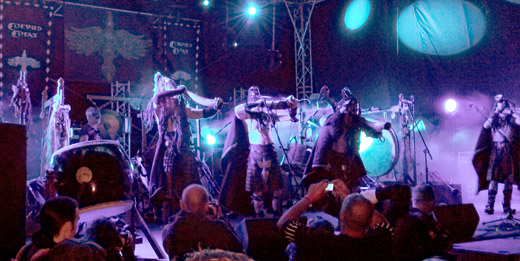
On the first night of the festival we were treated to a superb performance by the death metal band Kat (Polish for The Executioner), so accomplished and refined, that this crowd of Goths were for the moment transformed into head bangers. As the members of Kat took position, the eerie and thunderous strains of Mussorgsky’s “Night on Bald Mountain” boomed from speakers and swirling billows of smoke churned across the open air stage. Then out charged Roman Kostrzewski, the elder statesman of Polish heavy metal, his wild gray hair trailing around his grizzled face. He roared the lyrics in clear, articulate Polish to furious, speed-metal accompaniment and conducted the band with arm gestures and body language. Head-bangers in the crowd exploded into a brutal, violent mosh-pit, peopled by hulking Slavic giants and tiny, tattooed girls in Doc Martens.
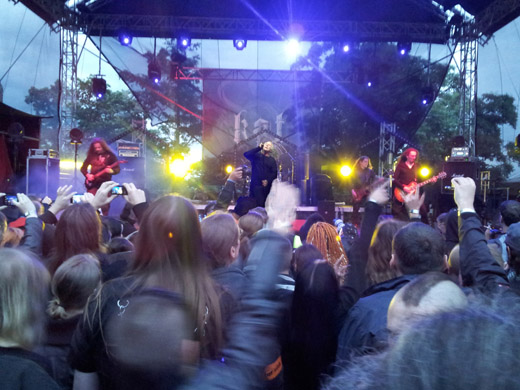
Roman Kostrzewski & Kat
On the second day we attended sessions featuring local and regional music groups at the converted church now serving as a music venue.

Gathering outside the former evangelical church/venue

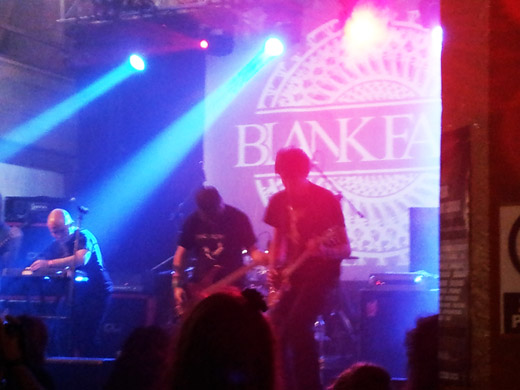
Jakub Avenarius. and Blank Faces
This proved to be all for the better, because walking down the hill into town we were treated to the sights of gorgeous and exotically attired Goths and steampunks, wearing every imaginable dark-themed costume, made up to extreme cosmetic excess, their hair dyed in the most intense and unnatural tints, coiffed into extravagant shapes. 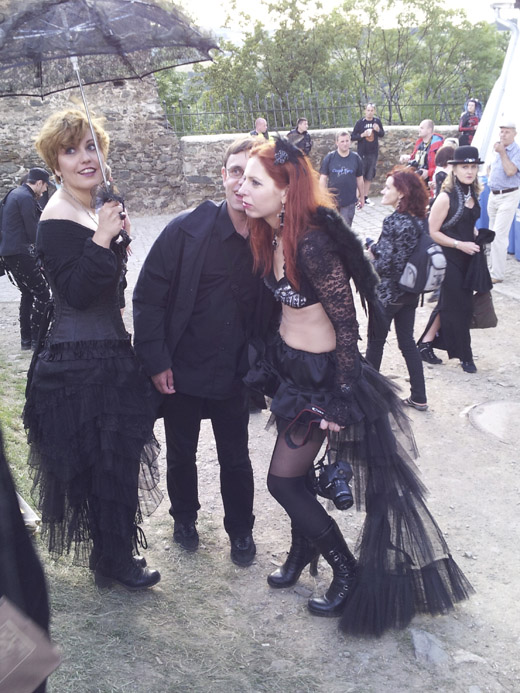


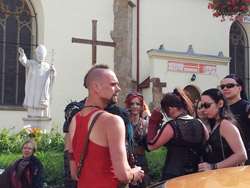

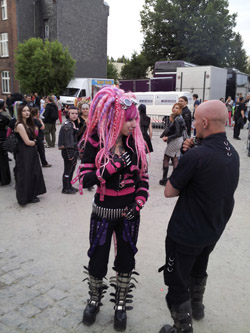
Some of them gathered under a statue of Pope John Paul II. Others clustered around strolling celebrity musicians.
As the third night fell we returned to the castle where Icon of Coil turned the now-densely packed audience into a massive rhythmically swarming hive with electronic, techno-industrial grooves. Thus the crowd was ready to receive the ultimate headliners, VNV Nation, who came out just before midnight, going right into a beloved favorite, “Space and Time.”
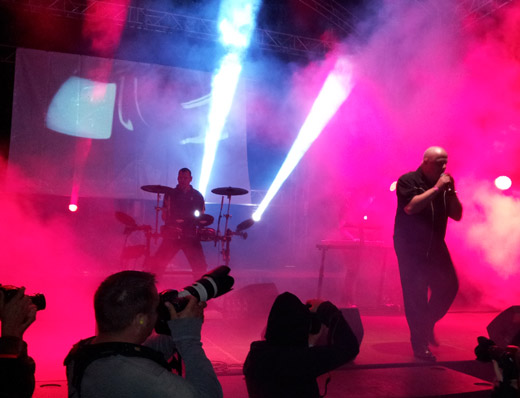
Electro-industrial, but at the same time uniquely heart-warming and sentimental, VNV’s set both energized and emotionally touched the audience. Frontman Ronan’s friendly patter was set against uplifting pieces from “Praise the Fallen,” “Ascension” and “Perpetual.” His exhorting the crowd to sing along was a bit distracting. Nevertheless, soaring synthesizers and hypnotic rhythms succeeded to uplift the overjoyed audience in a fitting conclusion to the live performances.

Front of the Hacienda Club
As on previous nights, the crowd regrouped at either of two clubs to snack, drink and dance until the early morning hours.  There were many styles forthcoming from the DJs, but our favorite, called “80s Trash Batcave” was heavy on Joy Division, Cure and Depeche Mode. Poles are about 20 years behind Americans in that most everybody still smokes. But, catching up to the U.S., smoking is prohibited indoors, so the clubs are basically indoor/outdoor establishments. The staff and the patrons are extremely friendly and polite, never showing any signs of hostility.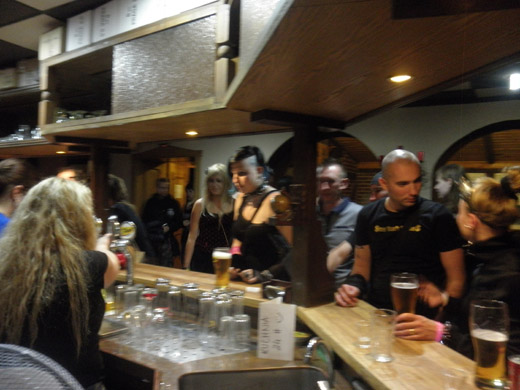
When the festival was over we visited the city of Wroclaw to view a huge, cylindrical, panoramic mural commemorating the victory of a rag-tag Polish peasant uprising, led by the American Revolutionary War hero, Thaddeus Kosciuszko, over the Imperial Russian Army. Their victory was short-lived, and Russians eventually crushed the rebellion, but not the spirit of the Polish nation.
On the streets of Wroclaw many wore Doc Marten-style boots and sported tattoos, piercings and punk hairdos in a rainbow of weird colors. All tee shirt statements were in English. Polish young people are remarkably fit-looking, healthy and athletic. Yes, even Goths and punks. In cities like Wroclaw and Warsaw, if you stop and do a 360º in any busy street or square, you are likely to spot a “10.”

Checking for a “10”
The experience at Castle Party Bolkow and everything we witnessed before and after it demonstrate Poland to be a nation happily awakening into the 21st Century from the nightmare of Communism.
June 1, 2013
Philadelphia PA
Featured below is the page as published in The Aquarian/East Coast Rocker
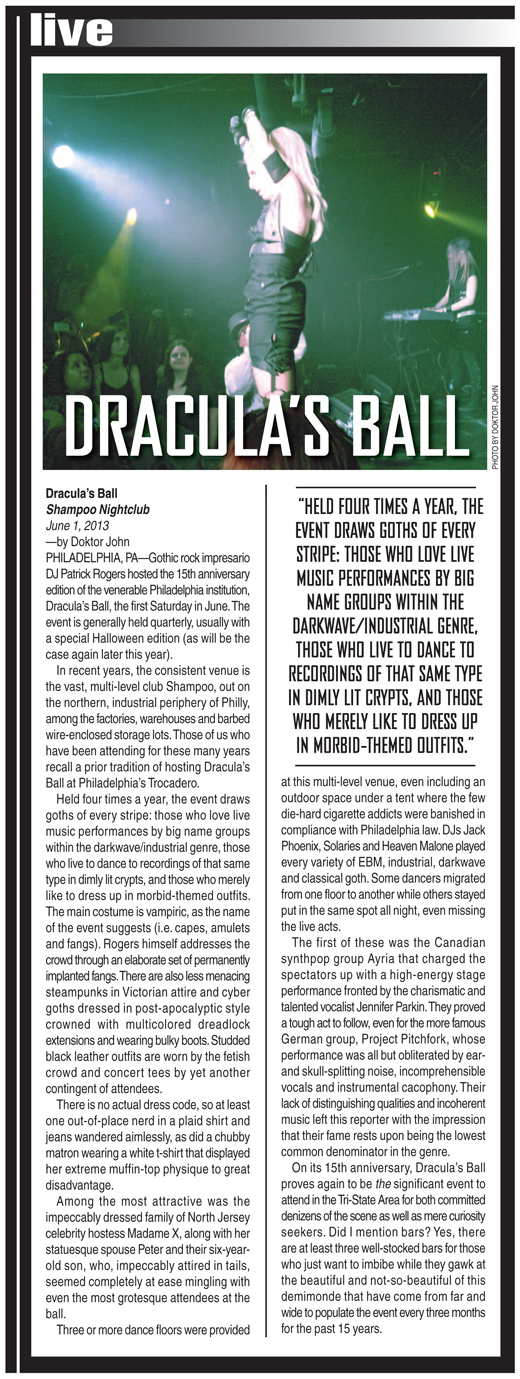
Below that is the original web page of www.doktorjohn.com
DJ Patrick Rogers addressing crowd at Dracula’s Ball
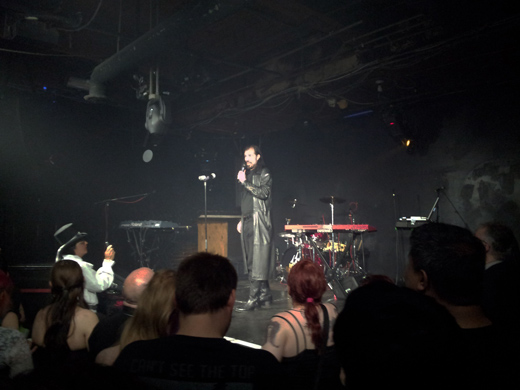
Gothic rock impresario DJ Patrick Rogers hosted the 15th anniversary edition of the venerable Philadelphia institution, Dracula’s Ball the first Saturday in June. The event is generally held quarterly, usually with a special Halloween edition (as will be the case again this year, 2013).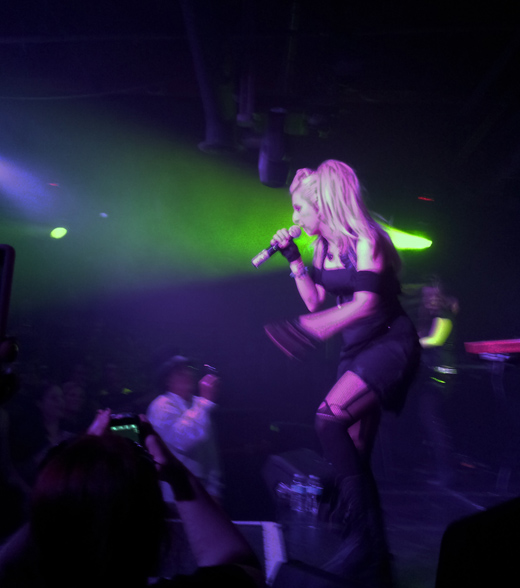
Jennifer Parkin of Ayria
In recent years the consistent venue is the vast, multilevel club, Shampoo, out on the northern, industrial periphery of Philly, among the factories, warehouses and barbed wire-enclosed storage lots. Those of us who have been attending for these many years recall a prior tradition of hosting Dracula’s Ball at Philadelphia’s Trocadero.
Held four times a year, the event draws Goths of every stripe: those who love live music performances by big name groups within the darkwave/industrial genre; those who live to dance to recordings of that same type in dimly lit, crypts; and those who merely like to dress up in morbid-themed outfits. The main costume is vampiric, as the name of the event suggests, i.e. capes, amulets and fangs. Rogers himself addresses the crowd through an elaborate set of permanently implanted fangs. There are also less menacing steampunks in Victorian attire and cyber Goths dressed in post-apocalyptic style crowned with multicolored dreadlock extensions and wearing bulky boots. Studded black leather outfits are worn by the fetish crowd and concert tees by yet another contingent of attendees.
There is no actual dress code, so at least one out-of-place nerd in a plaid shirt and jeans wandered aimlessly, as did a chubby matron wearing a white tee shirt that displayed her extreme muffin-top physique to great disadvantage.
Among the most attractive was the impeccably dressed family of north Jersey celebrity hostess Madame X, along with her statuesque spouse Peter and their 6-year old son, who, impeccably attired in tails, seemed completely at ease mingling with even the most grotesque attendees at the ball.
Three or more dance floors were provided at this multi-level venue, even including an outdoor space under a tent where the few die-hard cigarette-addicts were banished in compliance with Philadelphia law. DJs Jack Phoenix, Solaries and Heaven Malone played every variety of EBM, industrial, darkwave and classical Goth. Some dancers migrated from one floor to another while others stayed put in the same spot all night, even missing the live acts.
The first of these was the Canadian synthpop group Ayria that charged the spectators up with a high-energy stage performance fronted by the charismatic and talented vocalist Jennifer Parkin.

Ayria
They proved a tough act to follow, even for the more famous German group, Project Pitchfork, whose performance was all but obliterated by ear-and skull-splitting noise, incomprehensible vocals and instrumental cacophony. Their lack of distinguishing qualities and incoherent music left this reporter with the impression that their fame rests upon being the lowest common denominator in the genre.
Project Pitchfork
On its 15th anniversary, Dracula’s Ball proves again to be the significant event to attend in the tri-state area for both committed denizens of the scene as well as mere curiosity seekers. Did I mention bars? Yes, there are at least three well-stocked bars for those who just want to imbibe while they gawk at the beautiful and not-so-beautiful of this demimonde that have come from far and wide to populate the event every three months for the past 15 years.
Peter Murphy/ Webster Hall/

By Doktor John
May 7, 2013
The Godfather of Gothic Rock made the unlucky thirteenth stop on his tour of the East Coast, with eight more North American towns to go before heading overseas for another 20 cities in Europe, and then returning to the states to perform at 12 West Coast venues. The theme was to perform mostly Bauhaus material with a few other songs thrown in for variety, thus the title, “Mr. Moonlight Tour.” Bauhaus broke up in 1983, splitting into Peter Murphy, solo-vocalist and Love & Rockets, composed of all the other members. Certain remarks PM has made over the years have suggested that he considers his ongoing solo project to represent the continuation of Bauhaus. Most would agree that L & R, has spun further off from the original style than has Murphy.
Rare reunion tours occurred in1998 and 2006, and Bauhaus even reunited to produce a proclaimed “final” album, “Go Away White,” in 2008. The reunion performances, with the full complement of Bauhaus original musicians have been rightly acclaimed to be spectacular. This tour however follows a different plan, with vocalist Peter Murphy being the only representative from the original band, backed now by studio accompanists. That arrangement seems to have fallen short of the standard set by the original line-up.
Black leather-clad PM came on stage and the show opened with the pounding, morose sound of “King Volcano,” then the more melodious “Kingdom’s Coming” and then back to the pounding beats of “Double Dare.” Next he went into “In The Flat Field,” the melody of which is recognizable to fans of PM’s solo work, wherein it is resurrected as “The Line Between The Devil’s Teeth.”
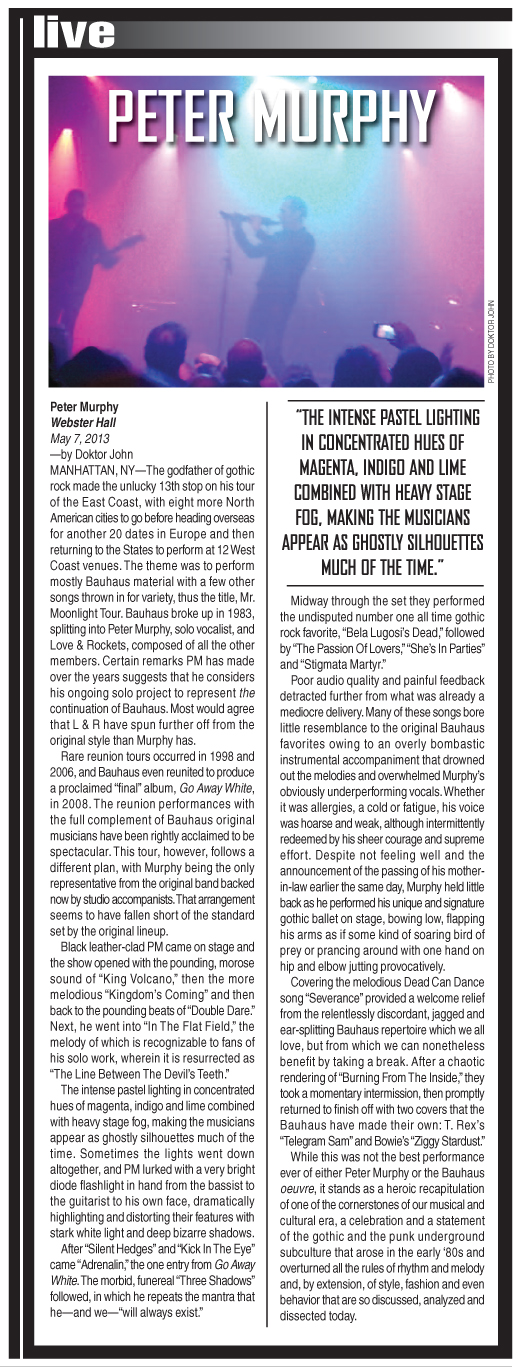
The intense pastel lighting in concentrated hues of magenta, indigo and lime combined with heavy stage fog made the musicians appear as ghostly silhouettes much of the time. Sometimes the lights went down altogether, and PM lurked, with a very bright diode flashlight in hand, from the bassist to the guitarist to his own face, dramatically highlighting and distorting their features with stark white light and deep bizarre shadows.
After “Silent Hedges” and “Kick In The Eye” next came “Adrenalin,” the one entry from the last reunion album, “Go Away White.” The morbid, funereal “Three Shadows” followed, in which he repeats the mantra that he – and we – “will always exist.”
Midway through the set they performed the undisputed number-one-all-time Gothic rock favorite, “Bela Lugosi’s Dead,” followed by “The Passion of Lovers,” “She’s In Parties” and “Stigmata Martyr.”
Poor audio quality and painful feedback detracted further from what was already a mediocre delivery. Many of these songs bore little resemblance to the original Bauhaus favorites owing to an overly bombastic instrumental accompaniment that drowned out the melodies and overwhelmed PM’s obviously under-performing vocals. Whether it was allergies, a cold or fatigue, PM’s voice was hoarse and weak, although intermittently redeemed by his sheer courage and supreme effort. Despite not feeling well and the announcement of passing of his mother-in-law earlier the same day, PM held little back as he performed his unique and signature gothic ballet on stage, bowing low, flapping his arms as if some kind of soaring bird of prey or prancing around with one hand on hip and elbow jutting provocatively.
Covering the melodious Dead Can Dance song, “Severance,” provided a welcome relief from the relentlessly discordant, jagged and ear-splitting Bauhaus repertoire, which we all love, but from which we can nonetheless benefit by taking a break. After a chaotic rendering of “Burning From The Inside,” they took a momentary intermission, then promptly returned to finish off with two covers that the Bauhaus has made their own: T. Rexs “Telegram Sam” and Bowies “Ziggy Stardust.”
While this was not the best performance ever of either Peter Murphy or the Bauhaus oeuvre, it stands as a heroic recapitulation of one of the cornerstones of our musical and cultural era, a celebration and a statement of the Gothic and the punk underground subculture that arose in the early 80s and overturned all the rules of rhythm and melody, and, by extension, of style, fashion and even behavior that are so discussed, analyzed and dissected today.
May 17, 18 and 19, 2013
Piscataway, NJ
By Doktor John

The Steampunk World’s Fair was held the weekend of May 17, 18 and 19 in Piscataway NJ and drew a crowd of participants large enough to fill two adjacent hotels – Embassy Suites and the Radisson – and any number of surrounding motels in the area. Steampunk, whether or not it remains under the mainstream radar, is huge. It is huge in the following it attracts and huge in the level of zeal of its fans. It is also almost boundless in the concepts and interests it encompasses.


Steampunk, for those who have yet to become familiar with the term, is an elaborate branch of geekdom, that derives its main inspiration from the unfulfilled science fiction of the past. The writings of Jules Verne (1828 – 1905) are seminal, with recurring themes drawn from “Journey To The Center Of The Earth,” “Around the World In Eighty Days” and “Twenty-Thousand Leagues Under The Sea.” Thus, airships, blimps, balloons as well as diving gear, giant squids and octopi have a revered place in the aesthetic of Steampunk.
The retro-futuristic angle of Steampunk owes a great deal to H.G. Wells (1866 – 1946) whose book “The Time Machine” introduces the concept of time-travel, putting that notion at the disposal of Steampunks who imagine an escape, both backwards into the 19th century and forwards into the distant future of technology.
The event took place at those two adjacent hotels, with the large, paved space in between them serving as a “midway” on which were hoisted large tents for vendors and exhibitors, called The Goblin Market, as well as huge performance and gathering spaces. Merchandise stands hawked incredibly creative artworks, personal adornments and home or office furnishings which featured the signature style of Steampunk, namely faux-antique, improbably engineered contraptions with elaborate mechanisms, featuring gears and sprockets, such as ray-guns, submarines, airships and deep-sea creatures. Likewise, the street level suites in both hotels were filled with vendors selling such Steampunk necessities as walking sticks, corsets, top hats and brass-accented jewelry.
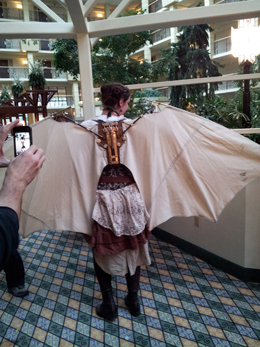
Events took place day and night, including a fashion show wherein convention-goers who chose to do so could display their often wildly individualistic, yet always thematic costumes, attired like characters in an R-rated version of Willy Wonka-meets-Game of Thrones. There were burlesque shows with unconventionally large female and uninhibited male strippers; fire-jugglers; a workshop on Bartitsu (walking-stick self-defense); ballroom dancing lessons, etc.
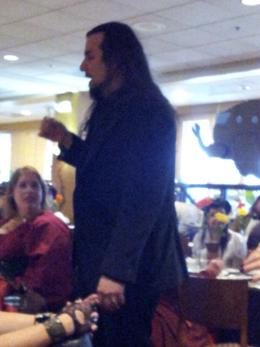

There was an absinthe-tasting event hosted by Goth celebrity Voltaire, whose wit remained dry despite swigs of rum between samples of the absinthe, and who performed his sarcastically-worded anti-folk favorites solo at a midnight show accompanying himself on a guitar. Music was everywhere, interesting and genre-bending. Emperor Norton’s Stationary Marching Band captured an outdoor audience with their rambunctious blend of brass, wind, string, accordion and drum performance featuring an occasional lapse into acrobatics by vagabond-attired but highly accomplished musicians. A totally fascinating show was put on by San Diego-based combo Steam Powered Giraffe, a bizarre musical group that accompanied their very interesting and listenable songs with robotic affectations, wearing metal-face make-up and performing comic routines in a manner reminiscent of Blue Man Group. An electric cellist performed on the mainstage and offered 17 hours of her music for sale on a USB storage device. A beautiful female vocalist from the duo Frenchy & The Punk was accompanied by a young man who set new standards for mastery of the guitar. 
Just as this account barely scratches the surface of musical acts at the Fair, the rest of this review comes nowhere near cataloging the imaginative and exhausting diversity of events and ongoing exhibits at kiosks, tables and concession stands or the assortment of individuals just wandering the grounds displaying their outlandish costume or hand-manufactured thingamajig.
It is impossible to set the boundaries of Steampunk at this time. The movement includes so many tributaries including historical re-enactment, eccentric musical styles, costumery, 19th century literature, sci-fi, fantasy and interests ranging from the low-tech, high design age of steam to Victorian parlor games, that it is beyond the scope of this report or any attempt to tie it all together. It is easier to compare Steampunk to the general category of geek interests —such as devotion to comic books, anime, computer games, role-playing, etc.—rather than to define it in its entirety. In fact I observed evidence that there were elements of overlap among these various subcultures. Its adherents are generally intellectual, intensely and obsessively committed devotees who are unwilling to settle for plain, vanilla reality, so instead avail themselves of this alternate world with all its fantasy identities, aesthetics, ideology and mutual self-acceptance.
Bravo to the organizer, Jeff Mach and minions for putting this all together for the Steampunk Worlds Fair 2013!
Your host, Mr. Steampunk
a.k.a “Steampop”

A zoomed-in close-up of that special tie

The ever-enlightening John Trause in a “mirror mask”

Hostess Marzena serving her favorite guest, the eminent author, John Trause

Erudite Joel Allegretti

Steve photographer, Laura Drager as Prince

Two Hughes boys

My boys, the jolly Alexander and Ian


Bishop “Ghost”

“Iron Chef” Marianne serves herself Fabulous Fare

Literary lecturers

Dissertation on Hurricane “Sandy” Preparedness

Peter CAPTURED BY AN OBAMA ZOMBIE!

Karen, Jozep and —————-Myke Hideous

Piano vandals Christopher and Viriatu

Goth Reunion, DJ Xian Engel and his fans

Our Gang
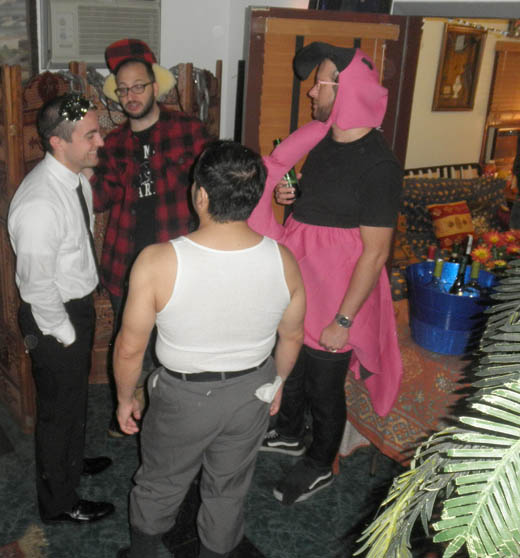
Miguel, Lisa, Artie, etc

Marty thought it was a “come-as-you-are party. Myke wanted us to know he has been working out

Dance floor crowd, Eiman, Michele, Diane, John, Marzena, & Joel

Supergirl moderates a theological debate between a gloom-metal bishop (Ghost) and a lay Franciscan

Music-room denizens

Egyptian deities in Peter Jaworowski and Madame X, Alda Xavier